

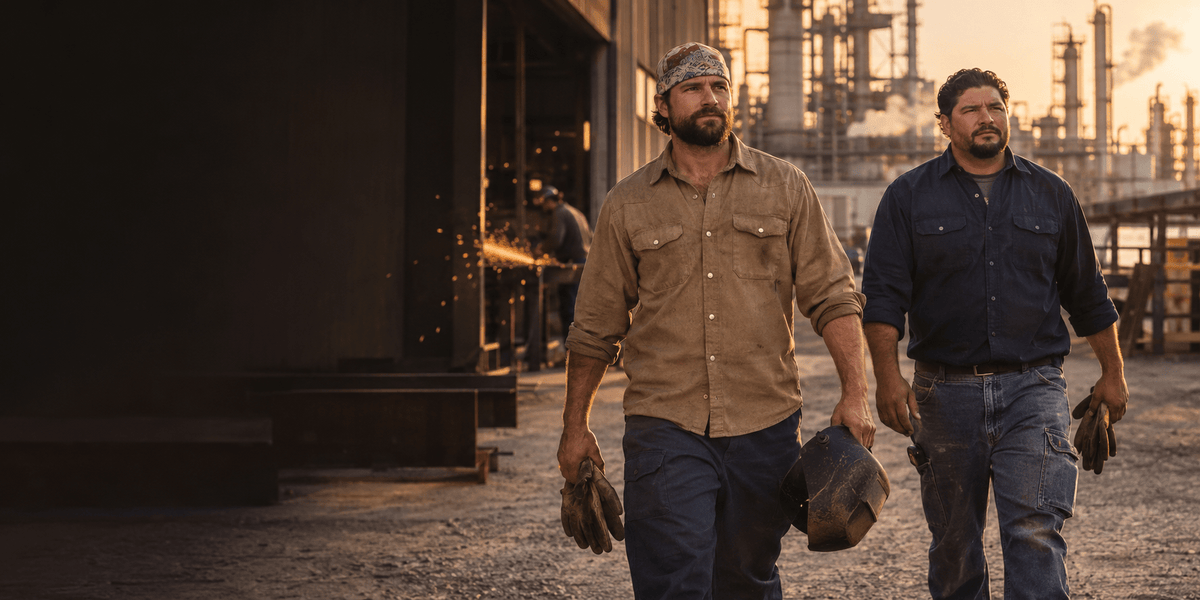
Your FR doesn't come with an expiration date. It comes with warning signs. Holes, bleach, oil that won't wash out, bad patches. Here are the 10 signs your flame resistant clothing is done, what to do about each one, and a checklist your whole crew can use.
Every crew has one. The guy whose FR shirt has been through three turnarounds, two hurricanes and a few hundred trips through the wash. The cuffs are shredded, there's a mystery stain on the chest, and he swears it's "broke in, not broke down."
He might be right. He might also be wearing a shirt that won't do its job on the one day it has to.
Here's how to tell the difference.
First, the big question: does FR clothing expire?
No. Quality flame resistant fabric that meets ASTM F1506 and NFPA 2112 holds its protection for the life of the garment, as long as you care for it the right way. The FR doesn't wash out and it doesn't have a shelf date.
What ends an FR garment's life is damage, contamination and wear. A hole is a hole, no matter how good the fabric around it is. Oil soaked into the fibers is fuel, no matter what the label says. So the question isn't "how old is it?" The question is "what shape is it in?"


Ten things to check.
1. Holes, tears and burn marks
If you can see skin, or the shirt underneath, through it, that spot isn't protecting you. Fire and arc energy find the gap.
The call: Small holes and tears can be repaired, but only with FR fabric and FR thread (more on that in #6). Large tears, multiple holes, or any burn or scorch mark: retire it.
2. Thin, worn-out spots
Knees, elbows, the seat, the front of the thighs. These go first. Hold the garment up to a light. If light comes through clearly where it shouldn't, the fabric's too thin to count on.
The call: Retire it. You can't patch your way out of fabric that's worn thin all over.


3. Frayed collars, cuffs and hems
A little fuzz on the cuffs is normal. Shredded edges, open seams and a collar that's coming apart are not. Your collar and cuffs sit right at your neck and wrists, two of the places you least want exposed. Further, frayed collars and cuffs are especially risky because the interlining placed within those parts of a shirts are often not flame resistant and could be fuel for flames in the event of an accident (flame resistant construction standards allows for the use of non flame resistant interlining so long as they are surrounded by flame resistant fabric).
The call: Minor fraying, keep an eye on it. Seams coming apart or edges unraveling into the body of the fabric: retire it or have it properly repaired.
4. Oil, grease, fuel or chemicals that won't wash out
This is the one that gets people hurt. Flame resistant fabric won't sustain a flame on its own, but oil, grease, fuel and solvents will. Soaked into your shirt, they're fuel sitting right against your body.
The call: If you get soaked, change out as soon as you safely can. If a stain or smell is still there after a proper wash, the contamination is still there too. Retire it.

5. Bleach exposure
Chlorine bleach can damage FR fabric and weaken the fibers. It usually leaves a calling card: blotchy, faded or discolored patches, especially on darker colors. That's why every FR care label says no chlorine bleach. Note that fabric softeners should also be avoided when washing FR clothing.
The call: If it's been bleached, take it out of rotation. It's not worth guessing. (Need a refresher? Here's Washing FR Clothing: The DOs and DON'Ts.)
6. Non-FR repairs, patches and logos
A patch sewn on with regular cotton-poly thread. An iron-on patch over a hole. A company logo heat-pressed on by a print shop that's never heard of NFPA 2112. Every one of those can burn or melt, and a melting patch on your chest is worse than no patch at all.
The call: Any repair, patch, embroidery or logo on FR has to be made with FR materials: FR fabric, FR thread, FR-rated emblems. If it wasn't, remove it and redo it right, or retire the garment.
A hole is a hole, no matter how good the fabric around it is.
7. Broken snaps, zippers and damaged reflective trim
An FR shirt that won't close leaves your base layer and chest wide open. Worse yet, a broken zipper could result in a compromised FR garment being stuck on you when it needs to be removed as quickly as possible. And on hi vis FR, the reflective trim has to be FR-rated too. Peeling, cracked or melted trim is a red flag.
The call: Replace broken hardware with FR-compatible parts, or retire it. Melted or damaged trim: retire it.


8. The fit has changed
FR works best with a little room. That air gap between the fabric and your skin adds insulation. A shirt that's shrunk tight loses it. Sleeves that ride up expose your wrists. A shirt that won't stay tucked leaves a gap at the waist. And gear that's way too big catches on things.
The call: If it doesn't fit right anymore, it doesn't protect right anymore. Size up and replace it. Every Rasco product page has a size chart, and we make a full line of FR Big & Tall workwear.
9. It's been through an incident
This one's non-negotiable. If your FR has been exposed to an arc flash or a flash fire, it did its job. Retire it, even if it looks fine. Damage you can't see is still damage.
The call: Retire it. Every time.
10. You can't read the label
The label is how you, your supervisor and a site auditor know what the garment is rated for: the standards it meets, its arc rating and CAT level. Faded to nothing or cut out? Nobody can prove what it is.
The call: Check your company's policy. Many safety programs require a legible label to stay in service.
Things that won't bring FR back
You'll hear about borax soaks, fire retardant sprays and other at-home tricks to "recharge" FR clothing. Skip them. None of them turn a damaged or worn-out garment back into certified protection. If it's done, it's done.
So how long does FR clothing last?
There's no honest number. A shirt worn twice a week in an office trailer and one worn six days a week on a turnaround are living two different lives. How long your FR lasts comes down to how hard you work it, how you wash it and how often you inspect it. If you have any question as to whether your FR clothing is too old, toss it and get a new one. Better to be safe and fully protected than to compromise your safety for the purpose of saving a couple of dollars.
That's why inspection beats any calendar.
For safety managers: build it into your program
NFPA 2113, the standard on selecting, caring for, using and maintaining FR garments, puts the employer in charge of setting inspection and retirement criteria. A program that actually works usually looks like this:
- Every wear: Workers do a quick visual check before they suit up.
- Every wash: Whoever's laundering (home, in-house or industrial service) pulls anything with damage or contamination.
- On a set schedule: A supervisor inspects every set against your written criteria.
- Tag it and pull it: Retired garments get marked and removed so they don't sneak back into a locker.
- Keep spares: If a worker has to wear a damaged shirt because it's his only one, the program has failed. Budget enough sets to rotate.
- Write it down: Track issue dates, repairs and retirements. It makes reordering easy and audits easier.
Quick FR inspection checklist
Screenshot it, print it, post it in the locker room.
- ☐ No holes, tears, burns or scorch marks
- ☐ No thin or see-through spots (hold it up to the light)
- ☐ Collar, cuffs and seams intact
- ☐ No oil, grease, fuel or chemical stains or smells after washing
- ☐ No bleach spots or discoloration
- ☐ All repairs, patches and logos made with FR materials
- ☐ Snaps and zippers close; reflective trim intact
- ☐ Still fits with room to move; sleeves cover wrists
- ☐ Never exposed to an arc flash or flash fire
- ☐ Label is legible
One "no" means it comes out of service.
Outfitting a whole crew? Crew & Company Accounts get volume pricing automatically at checkout: 10% off at 12+ pieces, 15% at 36+, 20% at 72+, mixed across styles, colors and sizes. The request takes about two minutes. Or shop FR workwear for safety managers & programs.
Before you buy: check if you get one free
Here's something most FR companies won't tell you about. If you bought your Rasco gear at full price on rasco.com in the last 12 months, and it got wrecked on the job, our Tough As You Guarantee includes a one-time Second Chances replacement. Same item or comparable, on us.
It covers real job site damage that makes the garment unusable, not normal wear and tear. Email support@rasco.com with your order number, a few photos and a quick story of what happened. We review claims within 5 to 7 business days and ship approved replacements free.
And every Rasco garment carries a one-year warranty against defects in materials and workmanship.
Time for new gear?
Rasco has been making workwear in Baton Rouge since 1988, built to be worn hard. Our NFPA 2112 garments are UL certified, and our FR meets ASTM F1506 and NFPA 70E. Mix any 3 pieces from the Core Collection and save 10%, no account needed.

8.7 cal/cm² · CAT 2 · from $65

8.7 cal/cm² · CAT 2 · from $65

10 cal/cm² · CAT 2 · $82

8.6 cal/cm² · CAT 2 · $95

10 cal/cm² · CAT 2 · $105

20 cal/cm² · CAT 2 · from $89

10 cal/cm² · CAT 2 · from $102

8.7 cal/cm² · CAT 2 · $75
Shop by category: FR Shirts · FR Pants · FR Jeans · Coveralls & Bibs · Jackets & Hoodies · Women's · Big & Tall · FR Base Layers
Replacing your shirt but still wearing a polyester tee under it? Read Do I Need an FR Base Layer?
Quick answers
Does FR clothing expire?
No. Quality FR keeps its flame resistance for the life of the garment when it's cared for properly. Damage, contamination and wear are what end its service life.
Does washing FR clothing reduce its protection?
Not when you follow the care label. What hurts FR is chlorine bleach, fabric softener, and contamination that doesn't get washed out.
Can I patch my FR clothing?
Yes, but only with FR fabric and FR thread. Regular patches, iron-ons and non-FR thread can burn or melt.
Can I put a company logo on FR?
Only with FR-rated emblems or embroidery thread. Standard heat transfers and patches can compromise the garment.
Can borax or a spray restore FR?
No. At-home treatments don't restore certified protection to a damaged or worn-out garment.
Should I keep wearing FR after an arc flash or flash fire?
No. Retire it, even if it looks fine.
Who decides when FR gets retired?
Your employer's safety program sets the criteria (NFPA 2113 puts that responsibility on them). You're the first line of inspection every time you put it on.
Still have questions about your FR? See our FR Workwear FAQ and The FR Workwear Guide, or call us at 225-273-3163. Rasco FR has been making flame resistant workwear in Baton Rouge since 1988.


Leave a comment